
How to Track Investor Engagement With Your Pitch Deck
Discover how to track investor engagement effectively with unique links and key metrics, boosting your chances of funding success.
August 24, 2026 · 9 min read

The most effective way to track investor engagement is to send every investor a unique tracked link or private room instead of a plain PDF, then watch three signals: time per slide, return visits, and where readers drop off. Do this today, before your next batch of outreach goes out.
- Create one canonical deck, then generate a separate tracked link per investor (or per cohort if you’re sending to a large angel list).
- Label each link with the investor’s name and outreach source so you know exactly who opened what.
- Check the dashboard daily during active outreach: prioritize anyone who returns to the deck a second time, and flag any slide where most readers stop.
Within a week you’ll know who to call first and which slide is quietly killing your raise.
Key Takeaways
Tracking investor engagement works when founders pair per-slide analytics with return-visit alerts, then use both to decide who to call and which slides to rewrite.
| Point | Details |
|---|---|
| Watch return visits first | A second or third open is the strongest signal of active investor interest and the top trigger for outreach. |
| Treat drop-off as a deck flaw | Repeated exits on one slide usually mean a narrative problem, not disinterest, and often need a bridge slide. |
| Label links before sending | Attribute every open to a specific investor and outreach channel by tagging links before, not after, you send them. |
| Track the document, not the person | Use expirations, watermarks, and limited access instead of persistent behavioral tracking to preserve investor trust. |
| BabyLoveRaise runs this automatically | A per-raise room with per-slide analytics, first-read alerts, and a free post-raise archive removes the manual setup work. |
Table of Contents
- Which Investor Engagement Metrics Actually Matter?
- How Do You Set Up Deck Tracking for a Raise?
- What Do Engagement Signals Actually Mean?
- Is It Ethical to Track How Investors Read Your Deck?
- How Does BabyLoveRaise Put This Playbook Into Practice?
- Why Most Founders Misread Engagement Data
- Start Tracking Your Next Raise Today
- Frequently Asked Questions
- Sources
Which Investor Engagement Metrics Actually Matter?
Not every number your tracking tool spits out deserves your attention. Some are noise; a handful are real signals of intent.
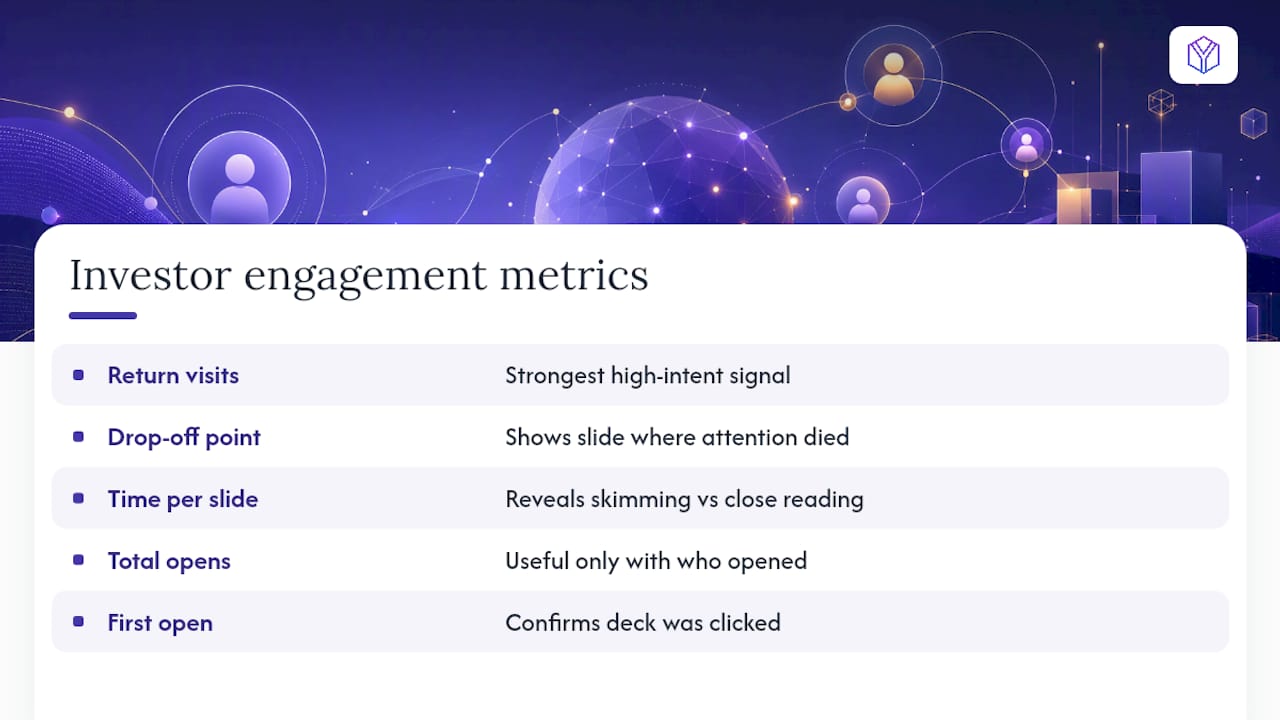
First open tells you the deck landed and got clicked, nothing more. Total opens matters only when it’s paired with who’s opening, since one investor refreshing the same tab five times looks identical to five different partners glancing at it once. Time per slide is where the real information lives: a founder who spends eleven seconds on your traction slide skimmed it, while one who lingers for a minute is reading numbers closely. Drop-off point flags the exact slide where attention died. Return visits are the single strongest high-intent signal in the whole dataset, because investors preparing for an internal committee discussion tend to reopen a deck rather than rely on memory. Downloads and video watch percentage round out the picture when your deck includes either.
Pro Tip: Watch trend direction, not just totals. A sharp drop in engagement from an investor who was previously opening every update is often an earlier warning sign than an outright pass, according to fundraising platforms that track engagement across investor touchpoints.
If you only have time to check one thing during a busy outreach week, check return visits first, drop-off points second.
How Do You Set Up Deck Tracking for a Raise?
Getting this running takes less time than writing one more cold email. Here’s the sequence:
- Build one canonical deck and turn on version control, so when you edit slide 8 next Tuesday you’re not accidentally sending investors an outdated version.
- Generate a tracked link or room per investor, or per cohort if you’re working through a large angel list. This is what makes attribution possible later.
- Label every link with the investor name and outreach channel (warm intro, cold email, demo day) at the moment you create it, not after.
- Turn on per-slide analytics so you can see dwell time slide by slide, along with return-visit alerts and download notifications.
- Set an expiration on older links so stale data doesn’t clutter your dashboard once a raise closes or an investor passes.
- Log every link label and event into your CRM or, if you’re pre-CRM, a plain spreadsheet with columns for investor, source, first open, and last activity.
Pro Tip: Do steps 1 through 3 before you send a single email. Retrofitting labels onto links you’ve already sent means you lose attribution on everyone who already opened the deck.
The whole setup runs quickly for most early-stage raises targeting a modest number of investors. For deeper detail on the tooling side, it’s worth reading how different platforms structure this before you commit to one.
What Do Engagement Signals Actually Mean?
Data without a decision attached to it is just a dashboard you check for reassurance. Here’s the triage logic that turns numbers into next steps.
Prioritize in this order:
- Anyone who returned to the deck a second or third time, especially within a few days of the first open.
- Anyone who reached your financials, traction, or go-to-market slides, since these are the sections investors skip past first if they’re not interested.
- Anyone whose time-per-slide is climbing on later reads, since it suggests they’re now reading with more attention, not less.
If several investors drop off on the same slide, treat that as a narrative problem, not a coincidence. Investor relations practitioners consistently trace repeated drop-off to a specific slide’s framing rather than to a technical glitch or investor disinterest, and the fix is usually editing that slide or inserting a short bridge slide that answers the objection before it’s asked. Check the per-slide analytics directly rather than guessing which slide is the culprit.
Timing matters as much as the signal itself. Call within a day of a return visit. Send a short, specific note if someone read the whole deck once but hasn’t returned in a week. Wait if someone opened it once for under thirty seconds; a follow-up too soon after a clear skim reads as pressure, not persistence.
Three quick scripts:
- Unopened after five days: “Following up in case this got buried, happy to send a two-line summary if that’s easier to act on.”
- Skimmed but no return visit: “Wanted to flag the traction numbers on slide six in case the deck didn’t do them justice.”
- Re-opened twice: “Saw you’ve been back through the deck, want to jump on a fifteen-minute call this week?”
More scripts and sequencing guidance live in this follow-up strategy guide.
Is It Ethical to Track How Investors Read Your Deck?
Track the document, not the person. Investors will tolerate knowing a deck records opens and slide dwell; they will not tolerate feeling profiled or watched.
- Set link expirations so old data doesn’t linger past its usefulness.
- Restrict dashboard access to your core team, not every advisor with a login.
- Use a watermark on downloads instead of persistent tracking pixels embedded in the file itself.
- Disclose tracking when a room is gated behind an email or when local law requires it; otherwise, standard document-level analytics on a shared link don’t need a disclosure banner.
Document-focused tracking that reports on slide behavior rather than building a personal profile of each investor keeps the relationship intact even when the news is bad.
How Does BabyLoveRaise Put This Playbook Into Practice?
BabyLoveRaise builds the exact workflow above into a hosted raise room instead of leaving founders to stitch it together from spreadsheets and screenshots.
- The room notifies you the moment an investor opens the deck for the first time, then tracks per-slide dwell so you can see who reached the financials and who stopped at the team slide.
- Because pricing runs per raise rather than per seat, you can generate as many tracked links as your target list needs without worrying about subscription tiers.
- Downloads carry a measured watermark instead of invasive tracking, and once your raise closes, the room converts to a free permanent archive rather than expiring behind a paywall.
Two silences that look identical on paper, an investor who never opened your deck and one who read every slide and quietly passed, are actually two different signals. Treating them the same is how founders waste follow-up energy on the wrong people.
Pro Tip: Export your engagement list before every partner call. Walking in knowing which three investors reopened the deck this week gives you a concrete talking point instead of a generic status update.
Why Most Founders Misread Engagement Data
The conventional advice treats engagement tracking like a scoreboard: more opens good, fewer opens bad. That’s the wrong frame. A deck that gets opened once for ninety seconds and never reopened isn’t a warm lead, it’s a pass that hasn’t been said out loud yet. Meanwhile a deck that gets reopened twice at odd hours, once at 11 PM and once the next morning, is very likely sitting in front of an investment committee right now.

What gets underrated is the editorial use of this data. Founders treat engagement tools as a way to rank investors, when the sharper use is diagnostic: which slide is losing people, and why. If four out of six investors stall on your market-sizing slide, that’s not four coincidences. That’s a slide that doesn’t answer the question investors are actually asking.
Prioritize the deck edit over the follow-up email. A better slide reaches every future investor; a better email reaches one.
Start Tracking Your Next Raise Today
BabyLoveRaise is built for exactly the workflow this article describes: one raise room per fundraise, per-slide analytics, first-read alerts, and return-visit detection, without paying for a seat-based subscription that outlives your raise. It suits founders running a pre-seed or seed round who want to know who’s actually reading the deck, and fundraising advisors managing several client raises at once through the white-label Operator tier.
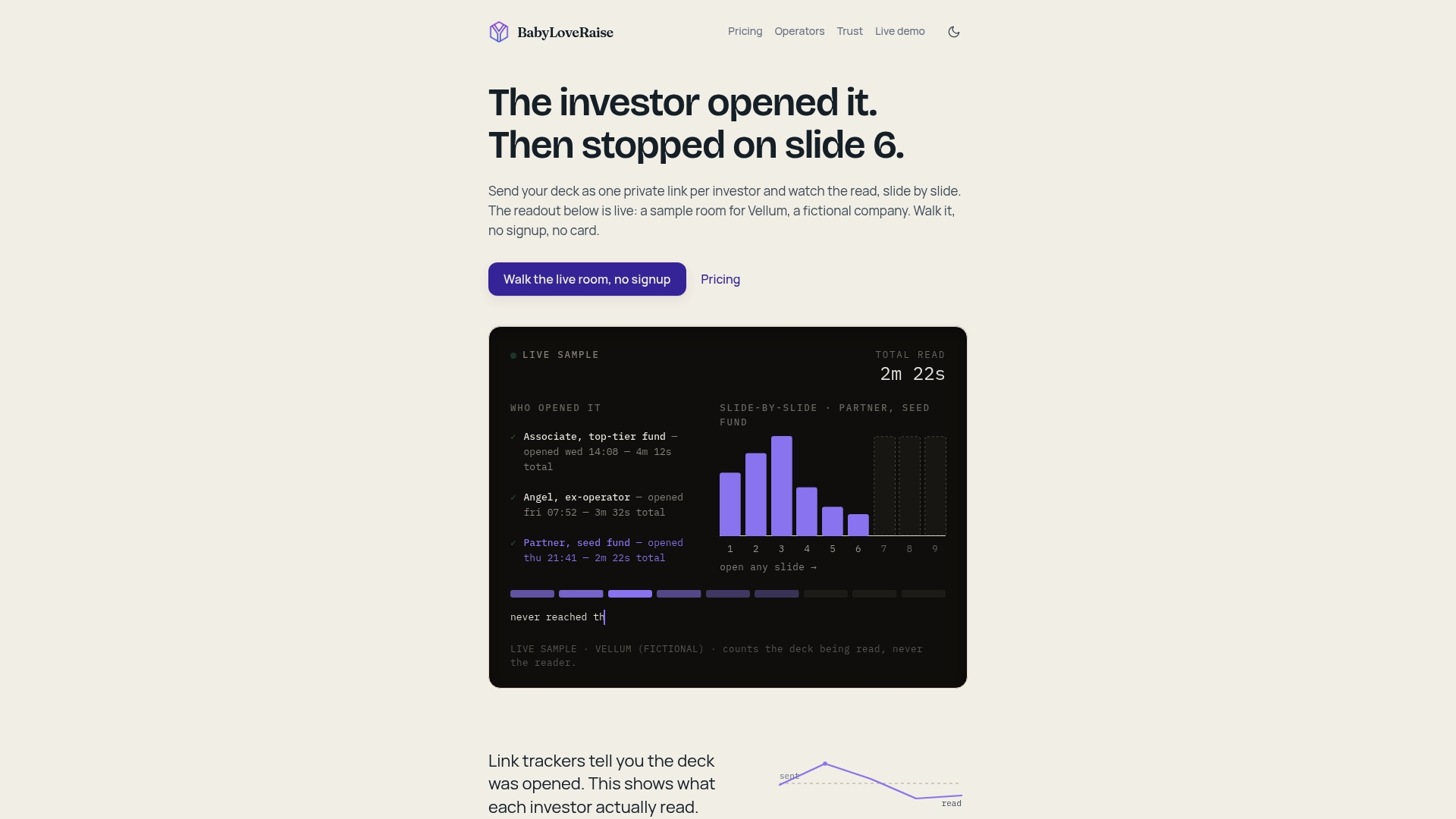
If you’re about to send your deck to a target list, set up your raise room at BabyLoveRaise first. You’ll get a notification on the first open, a live dashboard for the rest of the raise, and a free archive of the whole thing once the round closes.
Frequently Asked Questions
What’s the difference between tracking a link and using a full raise room? A tracked link tells you when a file was opened. A raise room adds per-slide dwell time, return-visit alerts, and download tracking in one dashboard instead of scattered link-by-link data.
How many investors should get a tracked link versus a plain PDF? Every investor you’re actively courting should get a labeled tracked link. Reserve plain PDFs only for casual forwards where attribution doesn’t matter, like a friend asking to see your deck out of curiosity.
Does tracking investor engagement damage the relationship if they find out? Not if the tracking is document-focused rather than personal. Investors expect data rooms and shared links to log activity; what damages trust is hidden surveillance rather than disclosed, slide-level analytics.
How soon after sending a deck should I check engagement data? Check within 24 to 48 hours for the first open, then daily for the first two weeks of an active raise, since that’s when most opens and return visits cluster.
What should I do if an investor never opens the deck at all? Send one short follow-up after five to seven days offering a shorter summary. If there’s still no open after a second attempt, move your energy to warmer leads rather than a third follow-up.
Sources
For more on consolidating investor touchpoints, see Backstop’s Activity Explorer. On prioritizing return visits, read PipelineRoad’s investor relationship guidance. On privacy-first design, see BabyLoveRaise’s take on tracking without surveillance. For slide order before you instrument anything, check how to build a pitch deck for investors.
- Activity Explorer for GPs: Track Every Investor Engagement | Backstop
- Investor Relationship Management Software | PipelineRoad