
What Is a Fundraising Deal Room, and How Do You Set One Up?
Learn how to set up a fundraising deal room to engage investors effectively. Discover essential tools for tracking engagement and optimizing success.
August 22, 2026 · 12 min read

A fundraising deal room is a secure, structured workspace where founders share a pitch deck and diligence materials with investors while tracking exactly who reads what. The immediate move: build a gated room with a canonical folder structure, then switch on engagement tracking before you send a single link. Once it’s live, three signals matter most.
- First-read notifications tell you the moment an investor actually opens the deck, not just receives an email.
- Per-slide dwell time shows which slides hold attention and which ones lose the reader.
- Audit logs give you a timestamped record of every open, download, and access change.
Get those three running first. Everything else, folder order, permissions, follow-up cadence, builds on top of them.
Key Takeaways
A fundraising deal room works when engagement analytics, not just document storage, drive who gets a follow-up and when.
| Point | Details |
|---|---|
| Structure comes first | Use the seven-folder canonical order, deck through team records, before inviting a single investor. |
| Security signals build trust | NDA gating, watermarking, and an exportable audit log tell investors you handle sensitive data responsibly. |
| Engagement beats guessing | First-read alerts and per-slide dwell separate “never opened” from “read and passed,” so follow-ups go to real readers. |
| Mobile access is non-optional | Investors often open decks on phones first, so full-screen viewing and fast load times matter as much as desktop design. |
| BabyLoveRaise fits the founder use case | Per-raise pricing, three link registers, and a free post-close archive target solo founders and advisors instead of enterprise deal teams. |
Table of Contents
- Deal Room Structure and Document Checklist for Fundraising Rounds
- Security, Access Controls, and Trust Signals Investors Look For
- Turning Engagement Analytics Into a Follow-Up Strategy
- How to Set Up and Run a Fundraising Deal Room Step by Step
- Common Mistakes That Slow Down or Kill a Deal
- Mobile Access and the Investor Experience
- Compliance and Legal Considerations for Sharing Sensitive Documents
- Where BabyLoveRaise Fits Into This Playbook
- Frequently Asked Questions
- Sources
Deal Room Structure and Document Checklist for Fundraising Rounds
Investors read decks in a predictable order, and a room that fights that order slows everyone down. A deal room built for a raise should follow a folder sequence that mirrors how a partner actually evaluates a company, not how your file system happens to be organized.
Here’s the order that works, and why it works:
- Pitch deck — the front door. Everything else exists to support the claims made here.
- Financials and model — historicals, projections, and the assumptions behind them, labeled by version and date.
- Cap table and capitalization history — current ownership, option pool, and any prior SAFEs or notes converting in this round.
- Legal agreements — incorporation documents, founder agreements, IP assignments.
- Customer references and contracts — signed agreements, letters of intent, logos with actual revenue behind them.
- Product and IP — technical documentation, patents or filings, architecture overviews if relevant.
- Team and payroll records — org chart, key hires, comp structure for anyone who’ll show up in a cap table later.
Version control matters more than founders think. Label every document with a date stamp (Financials_2026-02-14.xlsx, not Financials_FINAL_v3.xlsx) so an investor comparing notes with a partner isn’t working off two different files without knowing it.
Timing matters too. A teaser, just the deck and a one-page summary, is enough for a first conversation. Full diligence materials (cap table, legal, payroll) should stay gated behind a signal of real interest: a second meeting, a term sheet discussion, or an explicit request.
Pro Tip: Upload your cap table as a static PDF for early-stage sharing, then swap in a live spreadsheet only once an investor is deep enough in diligence to need to model scenarios themselves.
Security, Access Controls, and Trust Signals Investors Look For
Founders often treat security as a checkbox. Investors treat it as a signal about how the company will handle sensitive data later, as a vendor, as an employer, as a public company someday. A room with sloppy permissions raises questions before a single financial number gets scrutinized.
The controls that matter most for a raise:
- Folder and role permissions, so a first-time reviewer can’t accidentally open your legal folder.
- NDA gating on sensitive materials, triggered before access, not after a polite request.
- Watermarking on downloads, tied to the viewer’s name and timestamp.
- Time-limited links that expire instead of floating around indefinitely.
- The option to disable downloads entirely on your most sensitive documents, so viewing doesn’t mean owning a copy.
On the technical side, look for AES-256 or comparable encryption, SOC 2 or a third-party audit report, single sign-on, two-factor authentication, and an exportable audit log. Vendor materials across the fundraising software space consistently point to uptime and integrated trust signals as measurable drivers of user confidence, and the same logic applies directly to a raise room: investors notice when infrastructure feels solid.
You don’t need a security dissertation in your data room. A short statement, “AES-256 encryption, SOC 2 Type II hosting, full audit trail available on request”, covers it. For anything touching customer contracts with confidentiality clauses or IP assignments with ambiguous language, loop in counsel before you upload, not after an investor asks a pointed question about it.
Turning Engagement Analytics Into a Follow-Up Strategy
Two silences look identical without data: an investor who never opened your deck, and one who read every slide and quietly passed. A fundraising deal room with real analytics turns those into two different, actionable states, and that distinction should drive your entire follow-up sequence.
Four signals are worth trusting: first-read (did they open it at all), last slide reached (did they finish), per-slide dwell (where attention concentrated or died), and re-reads (did they come back a second time, often before a partner meeting).
Map those signals to a simple state machine:
- Never opened → the email got buried or the intro was weak. Resend through a different channel or a warmer intro.
- Opened, skimmed → they clicked through fast without landing anywhere. Low priority for now, but log the open.
- Opened, read fully → real engagement. A short, specific follow-up referencing something from the deck belongs here.
- Re-read or lingered on financials/traction slides → high interest. Prioritize a call within 48 hours.
- Asked questions → move to structured diligence immediately.
Timing compounds the effect. Fundraising research on virtual engagement shows that reminder timing tied to actual behavior produces measurably better response rates than blanket follow-ups sent on a fixed schedule. The first 72 hours after a send are the highest-leverage window: that’s when first-read events cluster and when a tailored note lands while the deck is still fresh in the investor’s head.
One caution: document a simple privacy note in the room itself. “We track document engagement to improve follow-up” is honest and sufficient. Avoid language that reads like surveillance, engagement tracking should feel like a professional courtesy, not a monitoring system pointed at the reader.
Pro Tip: If a slide shows consistently short dwell time across multiple investors, don’t just note it. Rewrite that slide before your next batch of sends. The room is telling you where the deck is failing.
How to Set Up and Run a Fundraising Deal Room Step by Step
Running a raise room well is mostly discipline, not tooling. Here’s the sequence that keeps a room clean from first send to close.
- Build the canonical structure first. Upload the seven core folders, set permissions by role, enable the NDA gate on legal and financial documents, and turn on analytics before anyone gets a link.
- Segment your invites. Use a teaser link for cold outreach, a private reviewer link for warm intros still evaluating fit, and a full investor login for anyone moving toward a term sheet. Keep a simple register of who received which link type and when.
- Centralize Q&A in one place. Answer questions inside the room rather than in scattered email threads, so every investor sees the same version of the truth and you’re not repeating yourself across ten inboxes.
- Label every update. When financials or the deck change, date-stamp the new version and note what changed, so an investor reviewing on Tuesday isn’t confused by a number that shifted on Thursday.
- Close and archive. Export a closing book with signed documents and timestamped activity records, then convert the room to an archive rather than letting access lapse into confusion.
Common Mistakes That Slow Down or Kill a Deal
A messy room signals a messy company, fairly or not. The errors that do the most damage: inconsistent cap-table versions floating across email and the room simultaneously, missing tax or payroll records that surface late in diligence, sensitive contracts left fully exposed instead of redacted, and unlabeled draft documents that make investors question which numbers are current.
Run this 48-hour fix before re-sharing:
- Reconcile every cap-table file to a single current version and delete the rest.
- Pull payroll and tax records into the team folder, even if incomplete, and note what’s pending.
- Redact customer-specific pricing or confidentiality-protected terms in contracts before upload.
- Rename every file with a version number and date, no exceptions.
Mobile Access and the Investor Experience
A meaningful share of investors open a deck for the first time on a phone, between meetings or during a commute, not at a desk. If your room renders as a shrunken desktop page or forces a download before viewing, you lose that first impression before the content even gets evaluated.

A room built for a raise needs mobile behavior that matches how investors actually work: full-screen slide viewing that doesn’t require pinching and zooming, fast load times on cellular connections, and no login flow so clunky that a busy partner gives up and asks an associate to forward the PDF instead. If watermarking or download restrictions are part of your security setup, they need to work identically on mobile, a security feature that only functions on desktop isn’t a security feature.
Notifications matter here too. If your room sends a first-read alert, it should reach you the same way whether the investor opened the deck on an iPad in a cab or a laptop in an office. The value of engagement analytics collapses if the underlying access experience is inconsistent across devices, because you’re then comparing behavior across two different products rather than one.
Test your own room on a phone before you send it to a single investor. Open every folder, try the Q&A module, download a watermarked file. If any of it feels awkward on a six-inch screen, fix it before that friction costs you a first meeting with someone who was ready to say yes.
Compliance and Legal Considerations for Sharing Sensitive Documents
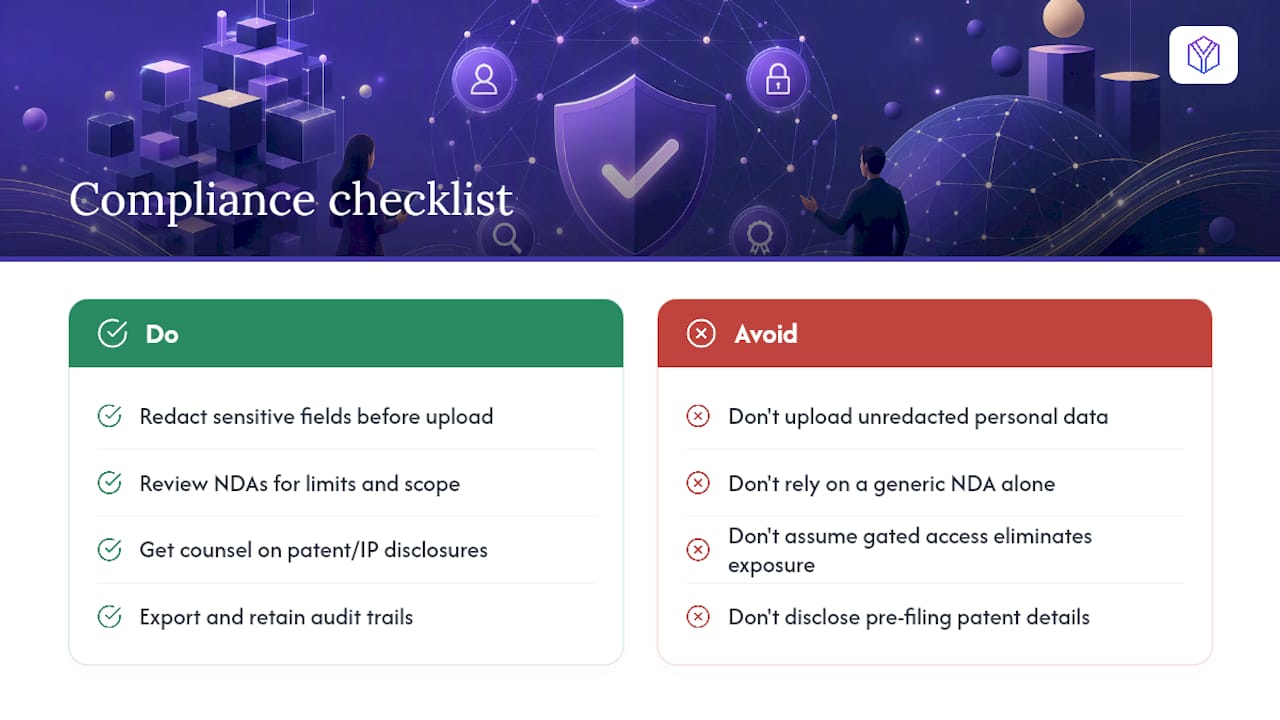
Fundraising documents carry real legal exposure, and a data room doesn’t remove that exposure just because access is gated. Cap tables often include personal information tied to option holders. Customer contracts may carry confidentiality clauses that restrict what you can show a third party without consent. Payroll records touch employee privacy in ways that vary depending on where your team is based.
Before uploading anything, ask whether a document needs redaction rather than full disclosure. A signed customer contract usually doesn’t need to reveal specific negotiated pricing to prove the relationship exists, a redacted version showing terms and signatures often satisfies diligence while protecting a counterparty’s confidentiality clause.
NDAs deserve more scrutiny than founders usually give them. A generic NDA template gating your entire room is better than nothing, but it won’t necessarily hold up as protection for highly sensitive IP or unfiled patent material. If your company has anything patentable in the product folder, get counsel’s view on what’s safe to disclose pre-filing versus what should wait.
Keep records of who signed what and when. An exportable audit trail isn’t just a nice feature. It becomes the paper trail that shows you controlled access to sensitive information responsibly, which matters if a dispute ever surfaces after the round closes. When in doubt on anything touching IP assignment, employee equity, or contractual confidentiality, a short call with counsel before upload costs far less than a problem discovered during a later round’s diligence.
Treating the Raise Room as an Active Fundraising Instrument
Most founders treat a data room as a filing cabinet: build it once, forget it, hope investors find their way through. That’s backwards. A room with live engagement data is a pipeline tool, it tells you where to spend your limited follow-up energy instead of guessing. The founders who win rounds faster aren’t the ones with the prettiest deck. They’re the ones who notice a re-read on the financials slide and pick up the phone that afternoon. If you’re building your first raise room, a purpose-built option beats retrofitting a generic file-sharing tool.
Where BabyLoveRaise Fits Into This Playbook
Every recommendation in this guide, gated structure, first-read alerts, per-slide analytics, mobile-friendly access, maps directly to how BabyLoveRaise is built. Instead of guessing whether an investor opened your deck, you get notified the moment they do, and a dashboard shows per-slide dwell so you know which slides earned attention and which got skimmed past.
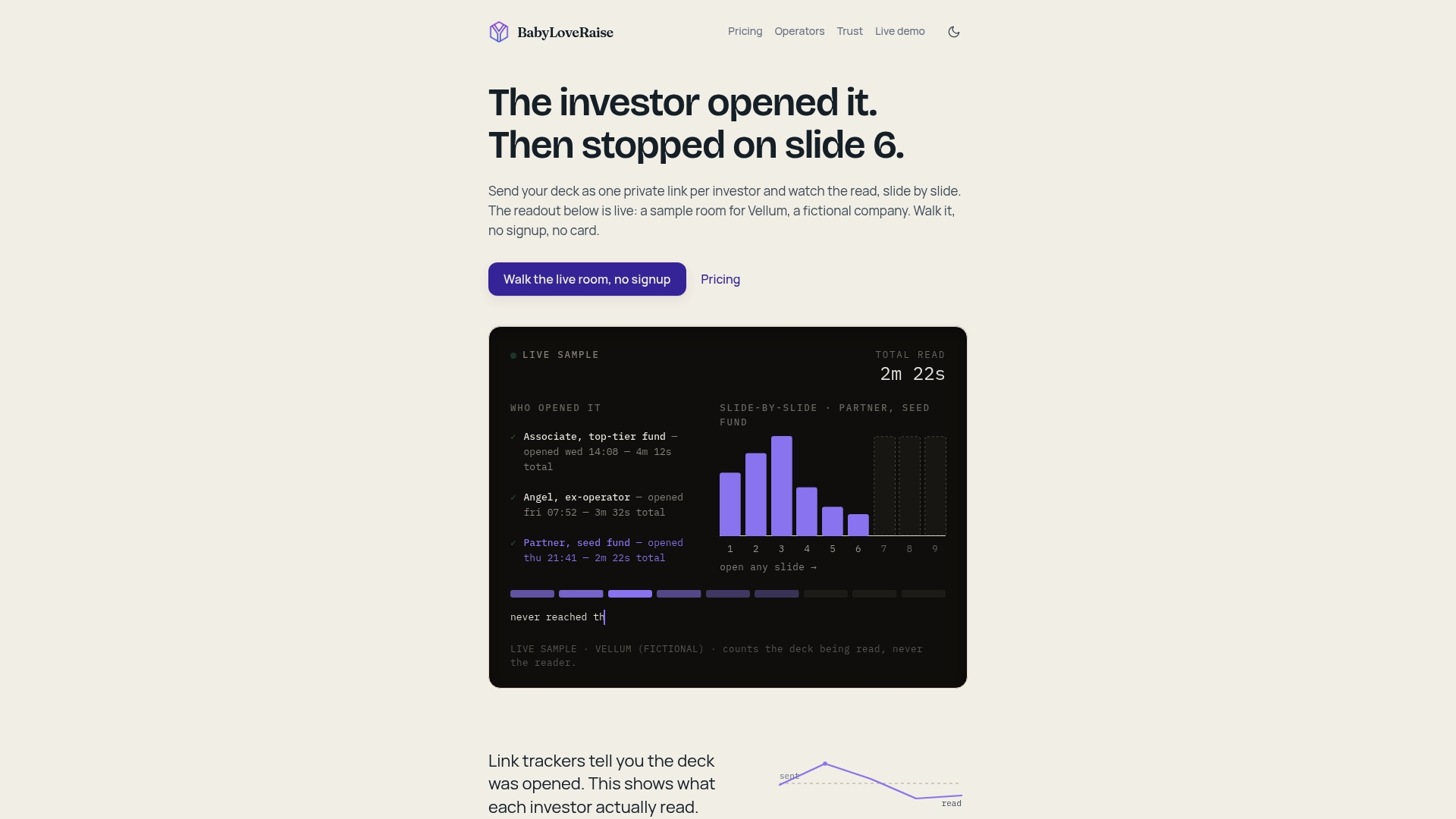
Share links come in three registers, first send, forwardable, and private, so you control exactly how a deck moves once it leaves your hands, and downloads can carry a measured watermark without slowing down the reviewer. Pricing runs per raise instead of per seat forever, which matters if you’re comparing data room pricing models built for enterprise deals rather than a single seed round. Fundraising advisors and fractional CFOs running multiple client raises can use the Operator tier to run firm-branded rooms across every client, instead of paying for separate enterprise licenses per engagement.
When your round closes, the room converts into a free permanent archive instead of hitting a paywall. If you’re preparing your first raise, start by building a structured deal room and turning on engagement tracking before your first send.
Frequently Asked Questions
What’s the difference between a fundraising deal room and a general virtual data room? A fundraising deal room is purpose-built around a single raise, with engagement tracking tied to investor behavior on a pitch deck. A general virtual data room is built for broader transactions like M&A and often prices per seat rather than per raise.
How long should a deal room stay open during a raise? Most raises run the room actively for the length of the fundraising process, typically a few weeks to a few months, then convert it to an archive once the round closes and signed documents are finalized.
Should every investor get access to the full deal room immediately? No. Start cold outreach with a teaser link showing the deck alone, then open fuller access, cap table, legal, financials, once an investor shows real interest through a second meeting or direct request.
What should founders do if an investor re-reads the deck but doesn’t respond? Treat a re-read as a strong interest signal and reach out within 48 hours with a short, specific note referencing something concrete, a metric, a slide, rather than a generic check-in.
Sources
- What is a Deal Room? — ShareVault
- Donorbox — fundraising and donor management
- Virtual gala & auction software — CharityAuctions