
Anonymous Document Analytics for Founders Running a Raise
Unlock the power of anonymous document analytics to boost your fundraising efforts. Track engagement to connect with interested investors effectively.
August 23, 2026 · 11 min read

Anonymous document analytics for raises record per-recipient, per-slide engagement so you can identify warm investors and prioritize follow-ups. Instead of one PDF disappearing into an inbox, you see who opened it, who read past the team slide, and who bailed after the market-size page. Two quick examples: a founder notices an investor returned to the financials slide three times in two days and books a call before the investor even replies to email. Another sees a deck opened once for ninety seconds and never touched again, and knows to stop chasing that name and spend the time elsewhere.
The verdict is simple: this kind of tracking turns a blind send into a prioritized list. You stop guessing which silence means “still reading” and which means “already passed.”
- Identify who finished the deck versus who dropped off early
- Spot the exact slide where attention consistently dies
- Rank your investor list by real engagement instead of gut feel
Key Takeaways
Anonymous document analytics work when per-slide dwell, return-visit sequences, and sharing behavior get paired with a fast, specific follow-up script rather than left sitting in a dashboard.
| Point | Details |
|---|---|
| Watch the right signals | Prioritize dwell time on problem/solution, team, and financials slides over raw view counts. |
| Read the return-visit pattern | A full first read followed by targeted returns to financials or team signals real interest. |
| Use one canonical link | Send a single raise room link per round instead of multiple deck versions to keep data comparable. |
| Match timing to engagement | Reach out within 24 to 48 hours for high engagement, 3 to 5 days for medium, one week for low. |
| Choose a raise-priced room | BabyLoveRaise reports per-recipient, per-slide engagement and archives free once your round closes. |
Table of Contents
- Which Signals Actually Predict Investor Interest?
- How Do You Set Up One Raise Link the Right Way?
- What Should Your Analytics Track (and What Should They Never Track)?
- Which Engagement Level Should Trigger Which Follow-Up?
- How Does BabyLoveRaise Fit This Playbook?
- What Are the Limitations of Anonymous Document Analytics?
- Why Generic Document Tracking Misses What Founders Actually Need
- Get a Raise Room Built for This Exact Playbook
- Frequently Asked Questions
- Sources
Which Signals Actually Predict Investor Interest?
Not every metric matters equally. Raw view counts are close to useless on their own. What separates a warm investor from a curious one is a specific pattern of behavior across three or four signals, and pitch deck analytics guides built from investor reading sessions back this up directly.
Per-slide dwell time is the clearest signal. Analysis of over 10,000 investor reading sessions found that time spent on the problem/solution slide, the team slide, and the financials page correlates strongly with an investor moving toward diligence. As a rule of thumb, anything under five seconds on a financials slide is a skim, not a read. Fifteen seconds or more, especially paired with a return visit later, is worth noting.
Return-visit sequences tell you more than a single session ever could. The pattern to watch for: a full first read lasting several minutes, followed by a second visit focused narrowly on problem/solution lasting a shorter time, then a third visit zeroed in on team and financials for a brief period. That sequence shows up repeatedly among investors who eventually take a meeting.
Sharing and internal forwarding matter just as much. When a deck gets opened by two or three distinct sessions from the same firm’s domain, that’s usually a partner looping in an associate, or an associate escalating to a partner. Either way, it’s a pipeline signal, not noise.
Red flags are just as informative. Watch for:
- Heavy dwell time on the appendix but almost none on the core narrative slides
- Consistent skipping of the traction or team slide across multiple recipients
- A single visit with no return, even after your follow-up email
Multiple fundraising guides caution against chasing vanity metrics like total view counts, since they don’t reliably predict who actually books a meeting.
How Do You Set Up One Raise Link the Right Way?
Running five different versions of your deck across email threads is how good signal turns into garbage data. One canonical link per round is the rule.
- Create a single raise room link and use it for every investor in the round. When you update the deck, update the room, not the link. This is the only way engagement data stays comparable across your whole pipeline, a point echoed in guidance on replacing emailed PDFs with trackable links.
- Tier your materials. Send a teaser or one-pager first, promote engaged readers to the full deck, and reserve financial models or cap tables for a diligence-stage room with tighter permissions.
- Gate strategically. Require an email address for the full deck if you’re sending cold, but skip the friction for warm intros where you already know exactly who’s opening it.
- Choose the right link register for each send. A first-send link tells you the initial reaction. A forwardable link tells you who’s sharing you internally. A private link, issued to one named person, tells you unambiguously who is reading, which matters once you move into diligence and want audit-trail-level clarity.
- Tag every recipient in your CRM before you hit send. Note their firm, their role, and how you got the intro. That five-minute habit is what turns a wall of engagement data into an actual follow-up list, and it’s a step advisory guides on tracking fundraising materials call out specifically.
Pro Tip: Label recipients with the reason for outreach, not just their name, “warm intro via Sarah” or “cold outbound, seen at demo day.” When engagement spikes weeks later, that context tells you exactly how to open the follow-up email.
What Should Your Analytics Track (and What Should They Never Track)?
The tracking here is document-level, not person-level surveillance. A raise room records what happens to the file: which page was open, for how long, and whether the session returned. It does not log keystrokes, capture screen recordings, or build a profile of the person beyond the fact that a link they were given got opened.
Security features worth expecting from any tool you use for this:
- Watermarks on downloads that mark the file to the specific recipient
- Optional email or login gating for sensitive stages like financials or cap tables
- Strong encryption at rest and in transit, the same baseline any credible virtual data room should offer
- A defined archival policy so your data doesn’t just vanish or linger indefinitely after the round closes
A short line in your outreach email removes almost all the friction around this: “This link lets me see when the deck’s been opened so I don’t chase people who’ve already reviewed it, nothing more granular than that.” Investors have seen tracked links before. What they haven’t seen is a founder being upfront about what the tracking actually does.
Which Engagement Level Should Trigger Which Follow-Up?
Data without a response plan is just a dashboard nobody acts on, a point research on VC-facing analytics makes directly. Sort your list into three tiers and move fast on the top one.
High engagement looks like a full read followed by a return visit to financials or team within 48 hours. Reach out within 24 to 48 hours with something specific: “Saw you spent time on the unit economics slide. Happy to walk through the model live if useful.” That’s a meeting-request situation, not a “checking in” email.

Medium engagement is a full first read with no return visit yet. Wait three to five days, then send a short nudge tied to something concrete in the deck: “Curious if the go-to-market slide raised any questions on our channel mix.” This is where you offer more material rather than push for a call.
Low or no engagement is a deck opened once for under a minute, or never opened at all. Give it a week, then send one more light touch, maybe a company update or a relevant metric, before moving that name down your priority list.
- High: 24 to 48 hours, direct, specific, meeting ask
- Medium: 3 to 5 days, question-based, offer more detail
- Low: 1 week, low-pressure nudge, then deprioritize
| Engagement Level | Signal Pattern | Follow-Up Timing |
|---|---|---|
| High | Full read plus return visit to financials or team | 24 to 48 hours, request a call |
| Medium | Full first read, no return visit yet | 3 to 5 days, ask a specific question |
| Low | Single short visit or no open at all | 1 week, light touch, then move on |
How Does BabyLoveRaise Fit This Playbook?
BabyLoveRaise builds this exact workflow into a hosted raise room rather than asking you to stitch together a generic file-sharing tool and a spreadsheet. You get a first-read notification the moment an investor opens the deck, per-slide attention data for every recipient, and an owner dashboard that separates “never opened it” from “read everything and passed,” two silences that look identical in a normal inbox but mean completely different things for your next move.
The tracking stays document-level by design: no keystroke logging, no browsing history, just engagement with the file itself. Downloads carry a measured watermark, and once your raise closes, the room converts to a permanent free archive instead of hitting a paywall the way some document-tracking tools do after a trial period ends.
- First-read alerts the moment a recipient opens the room
- Per-slide dwell reported per investor, not just in aggregate
- A dashboard state that distinguishes unopened from read-and-passed
- An Operator tier for fractional CFOs and advisory firms running multiple client raises under one firm-branded room
The whole point of pricing this per raise instead of per seat forever is that a raise has a start and an end. You shouldn’t keep paying for deck analytics eighteen months after your round closed.
Pro Tip: If you’re a solo founder without a cofounder to sanity-check reactions, per-slide dwell data is the closest substitute you’ll get, it shows you exactly where a real reader’s attention wandered.
What Are the Limitations of Anonymous Document Analytics?
Engagement data tells you attention, not intent. An investor who spent four minutes on your financials slide might be genuinely excited, or might be a skeptical analyst building a case to pass. The metrics narrow your guesswork; they don’t replace a conversation.
Corporate firewalls and VPNs can also distort session data, sometimes making one investor’s multiple opens look like several different viewers, or masking a single long session as fragmented ones. Treat unusual patterns as a prompt to look closer, not as gospel.
There’s also a real risk of over-indexing on the deck itself. A perfect slide-by-slide read means nothing if the underlying business doesn’t hold up in a live Q&A. Analytics tell you who’s paying attention, not who’s going to write a check.
Finally, this data only works if you actually act on it. Watching a dashboard without sending timely, specific follow-ups is the same as not tracking anything at all, the data just sits there looking impressive. The return on this kind of tracking comes entirely from the response, not the observation.
Why Generic Document Tracking Misses What Founders Actually Need
Most document-tracking advice treats a fundraising deck like any other file share: a PDF, a link, a view count. That framing misses the two things that actually matter during a raise: timing and per-slide narrative structure. A sales deck doesn’t have a “team slide” problem. A pitch deck almost always does.
The conventional wisdom, track opens, notify on view, is table stakes at this point. What’s underrated is treating return-visit sequencing as a diagnostic tool for your own narrative. If investors keep circling back to your financials slide without ever revisiting the team slide, that’s not a red flag on the investor, it’s a signal your team story isn’t landing on the first pass.
Founders should prioritize the follow-up script over the dashboard. The data is only as useful as the speed and specificity of what you do with it. A founder who checks the dashboard obsessively but sends generic “just checking in” emails is wasting the entire advantage this kind of tracking gives them.
Get a Raise Room Built for This Exact Playbook
BabyLoveRaise is the alternative to emailing a PDF and hoping for the best, or paying enterprise data-room prices for a deck that only needs to live for one raise. You get one link, per-slide engagement for every investor, and a dashboard that tells you exactly who’s warm right now, all priced for the length of your actual round instead of a forever subscription.
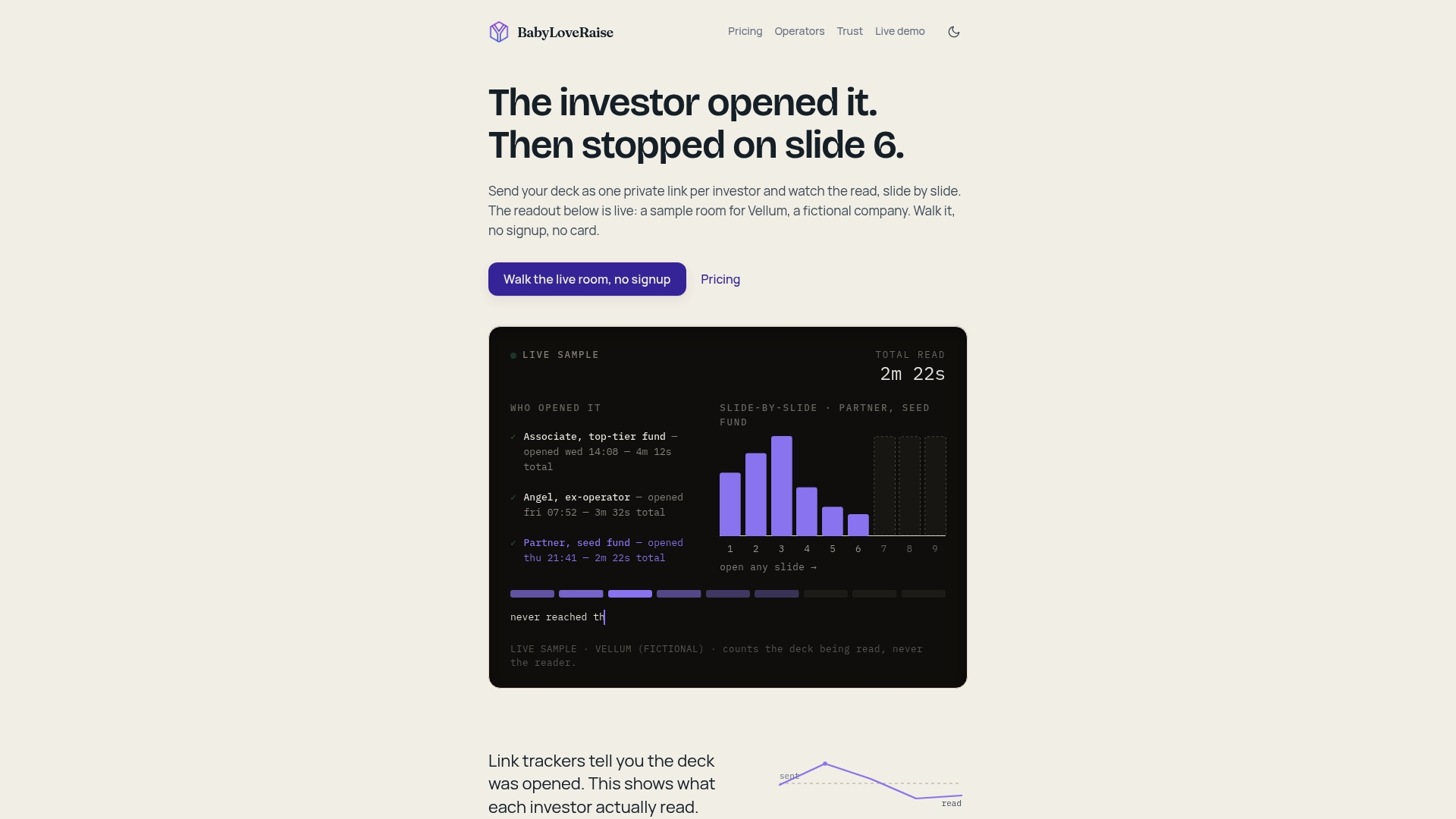
If you’re a solo founder, the per-slide data doubles as the cofounder gut-check you don’t have in the room. If you’re a fractional CFO or advisory firm running several client raises at once, the Operator tier gives you firm-branded rooms across every client without the per-seat pricing that virtual data rooms usually charge. Once your raise closes, your room converts to a free permanent archive instead of vanishing behind a paywall.
Set up your raise room before your next send and start seeing which slides actually hold attention.
Frequently Asked Questions
What counts as “anonymous document analytics” in fundraising? It refers to per-recipient, per-slide engagement tracking on a pitch deck during a live raise, who opened it, how long they spent on each slide, and whether they returned, reported at the document level rather than through personal surveillance.
Does this kind of tracking violate investor privacy? No. The tracking records what happens to the file itself, opens, page time, downloads, not personal browsing history or activity outside the document, and a short disclosure line in your outreach email covers most concerns upfront.
How soon should I follow up after seeing high engagement? Within 24 to 48 hours, ideally referencing the specific slide that held their attention rather than sending a generic check-in.
What’s a red flag versus a good sign in the data? Heavy appendix dwell with no core-slide engagement, or a single visit with no return, are red flags. A full first read followed by a targeted second visit to financials or team is one of the strongest positive patterns.
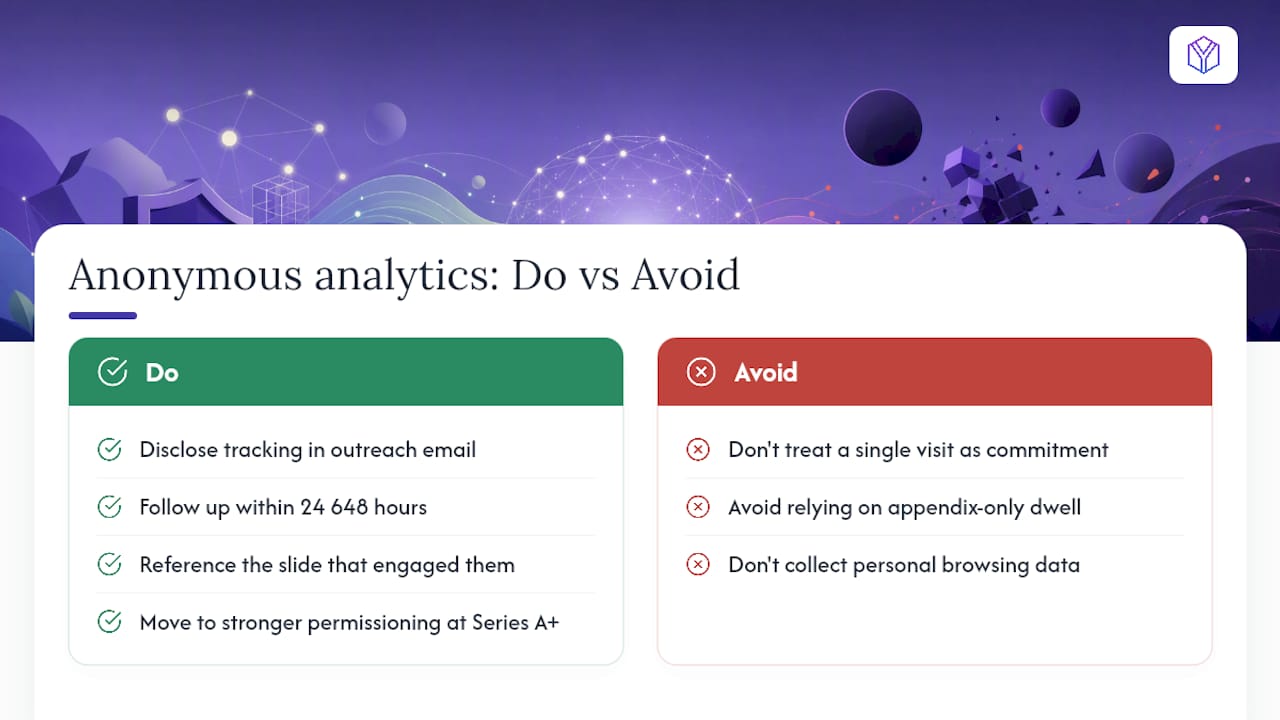
Do I need a full virtual data room for early pitch decks? Not usually. Basic per-slide and session analytics cover angel and seed-stage sharing well; move to stronger permissioning and audit trails once you’re deep into diligence with a Series A or later round.
Sources
- The Only Pitch Deck Analytics That Actually Matter (Spoiler: It’s Not What You Think)
- VC Pitch Deck Analytics: Know What Investors Actually Read — SendNow Blog
- How to Share and Track Fundraising Materials With Investors
- How to Build a Fundraising Data Room That Wins VC Trust